

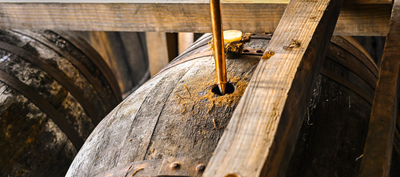


Single grain Scotch whisky rarely occupies centre stage, yet the Strathclyde single grain Scotch whisky released as Douglas Laing’s XOP 35 Years Old offers a compelling reason to reconsider that hierarchy. Distilled in September 1987 at the Strathclyde Distillery in Glasgow and bottled in May 2023, this Strathclyde 35 year old whisky is drawn from a single refill barrel and presented at natural cask strength (45.5% ABV), without colouring or chill filtration. With just 190 bottles worldwide, it stands as a limited edition Scotch whisky that captures the long, quiet evolution of grain spirit over more than three decades.
For collectors and those exploring rare single grain Scotch whisky, this is a bottle that rewards both curiosity and ownership.
Grain whisky begins differently from malt. And that difference matters over time.
A single grain Scotch whisky is distilled in continuous column stills, producing a lighter, cleaner spirit that evolves more gradually during long maturation. In youth, it can appear restrained. But given decades, it softens, deepens, and develops a layered sweetness that speaks less of distillation and more of time itself.
Douglas Laing’s XOP Strathclyde 35 Years Old sits precisely within that transformation. It invites a reframing of grain whisky - not as a supporting component, but as a category capable of quiet complexity and depth. The choice of a refill barrel is central to this. Rather than imposing dominant oak influence, refill wood allows the spirit’s natural sweetness to evolve slowly, integrating gentle spice and structure over time. After thirty-five years, the result is a whisky that feels composed rather than constructed.
On the nose, the whisky opens with a sense of polish and restraint. Sweet caramel leads, rounded and inviting, followed by the soft sheen of aged oak. There is warmth here - subtle, spiced, almost cinnamon-like - that lingers without overwhelming. It does not rush forward. It unfolds.
The palate reveals where long-aged grain whisky distinguishes itself most clearly: texture. Silky and fluid, it moves with a softness that belies its age. Toasted nuts emerge first, accompanied by a warmth reminiscent of bourbon sweetness. Then deeper sugars begin to unfold - muscovado, dark and rich, followed by a thread of maple syrup that brings both sweetness and structure. This is not a whisky built on contrast. It is built on progression.
The finish settles into something quieter, but no less complete. Long, smooth, and indulgent, it carries a lingering sweetness supported by subtle spice and elegant oak. Nothing feels forced. The sweetness remains present, tapering gently rather than fading abruptly. It is, in every sense, balanced.
To understand why a Strathclyde single grain Scotch whisky aged 35 years holds value, one must consider both rarity and time. Age alone does not guarantee quality; many casks fall out of balance long before reaching such maturity. What distinguishes this release is equilibrium - the way the spirit and wood have evolved together without one overtaking the other. Thirty-five years is not simply a number. It is a threshold few casks cross successfully.
Scarcity reinforces that significance. With only 190 bottles drawn from a single cask, this whisky exists as a finite record. Once opened, collected, or consumed, it cannot be replaced. This is what positions releases like this within the realm of rare whisky investment - not speculative, but finite. A closed story, held in glass.
For those approaching grain whisky for the first time, a common question remains: is it as good as single malt? The answer lies in perspective. Malt whisky often delivers intensity earlier, shaped by pot still distillation and more active cask influence. Grain whisky evolves more slowly. Given time, it develops a smoother, more integrated profile - less overtly assertive, but often more refined in texture and sweetness. At thirty-five years, that distinction becomes an advantage.
The decision to bottle this whisky at cask strength reinforces its authenticity. At 45.5% ABV, it retains the integrity of the spirit as it emerged from the cask. Nothing has been softened or standardised. Combined with the absence of colouring and chill filtration, this ensures that what is experienced in the glass is an unaltered expression of its maturation.
Douglas Laing’s role in this process is one of stewardship. As independent bottlers, they extend the narrative of Scotch whisky beyond official distillery releases, selecting individual casks that offer something distinct. Within the XOP range, the focus remains clear: age, rarity, and natural presentation. Each bottle is not a batch. It is an individual.
What emerges from this Strathclyde cask is not a statement piece. It is something more considered. It does not seek to compete with louder styles or more familiar categories. Instead, it offers a different perspective - one shaped by patience, by quiet evolution, and by an understanding that complexity does not always need to announce itself.
To approach a whisky like this is to slow down. Allow it time in the glass. Let the aromatics widen. A small addition of water can reveal softer spice beneath the sweetness, expanding rather than diluting the experience. Mature grain whisky rewards attention in a different way. Less immediate, perhaps - but more enduring.
In the end, the XOP Strathclyde 35 Years Old suggests a shift in how whisky might be valued. Not for intensity alone, but for balance, texture, and time. It demonstrates that single grain Scotch whisky, often overlooked, possesses its own expressive language - one defined by elegance, softness, and the long arc of maturation.
And perhaps that is its quiet appeal. In a category often driven by visibility and noise, this is a whisky that speaks more softly.
But for those who understand it, that is precisely the point.
