

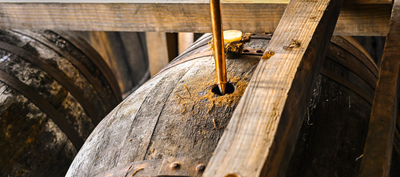


There is a different kind of quiet inside Scotland’s grain distilleries. Unlike the romanticised stone buildings of single malt lore, these are places of scale—industrial, precise, almost anonymous in their efficiency. Yet behind that steel and structure lies something unexpected: a spirit designed not for immediacy, but for patience. Grain whisky, often overlooked in favour of its malted counterpart, is built for time in a way few realise. Given decades, it softens, deepens, and evolves into something remarkably refined.
It is precisely this transformation that independent bottlers such as Douglas Laing have long sought to capture. Through their Xtra Old Particular (XOP) range, they act less as producers and more as custodians—identifying those rare casks that have quietly reached a point of completeness. Their philosophy, “As Natural As It Gets,” is not branding so much as restraint: no colouring, no chill-filtration, no interference. The whisky is drawn, bottled, and presented exactly as the cask intended.
Within this framework emerges a particularly rare example: a single grain Scotch whisky from the North British Distillery, distilled in July 1988 and matured for thirty-five years in a refill hogshead. Bottled at natural cask strength - 43.1% ABV - this 35 year old whisky forms part of Douglas Laing’s XOP series, with just 167 bottles released worldwide. It is, by any definition, a limited edition whisky, but more importantly, it is a singular one: a single cask Scotch whisky that will never be replicated.
To understand why such a whisky matters is to reconsider grain whisky itself. Produced in column stills, grain spirit begins life lighter and more delicate than malt whisky. For that reason, it has historically been used in blends, valued for structure rather than individuality. But when left to mature for decades - far beyond the timelines of most commercial releases - it undergoes a quiet transformation. The lighter spirit allows the oak to integrate more seamlessly, resulting in a whisky of remarkable smoothness and layered sweetness. In this sense, aged grain whisky is not a lesser category, but a different one - arguably one of Scotch’s most understated luxuries.
On the nose, the North British 35 Years Old opens with an immediate sense of polish. Sweet caramel rises first, rounded and inviting, followed by the gentle sheen of well-aged oak. There is warmth here, but it is controlled - a soft, spiced note that suggests cinnamon rather than heat. It is the kind of aroma that feels composed, as though each element has settled into place over time.
The palate reveals where grain whisky, at this age, distinguishes itself most clearly. The texture is notably silky - almost weightless at first, before unfolding into something richer. Notes of toasted nuts emerge, alongside a warmth reminiscent of bourbon sweetness, a nod perhaps to the cask’s past life. As it develops, deeper sugars come forward: muscovado, with its dark, almost molasses-like depth, and a thread of maple syrup that lends both sweetness and structure. This is not a whisky of sharp contrasts, but of gradual transitions, each layer building upon the last.
The finish extends with quiet confidence. It is long, smooth, and indulgent, the sweetness lingering without cloying, supported by a subtle spice and an elegant oak structure that holds everything together. Nothing feels excessive; nothing falls away too quickly. It is, in the truest sense, balanced.
For collectors and enthusiasts, the appeal of such a whisky lies partly in its rarity, but also in its perspective. A 35 year old whisky represents not just time, but survival - three and a half decades in which the cask has neither overpowered the spirit nor allowed it to fade. That balance is difficult to achieve, and increasingly uncommon. With only 167 bottles drawn from this single cask, scarcity is not an abstraction but a reality. Once these bottles are dispersed, the cask ceases to exist in any meaningful sense.
There is also a growing recognition that such releases occupy a distinct place within the broader whisky landscape. As the market for single malt continues to expand - and, in some cases, saturate - older grain whiskies have begun to emerge as a collector’s discovery category. Their relative scarcity, combined with their unique flavour profile, positions them as a compelling form of rare whisky investment. Not because they are speculative, but because they are finite, and increasingly appreciated.
Yet the question remains: is a single grain Scotch whisky comparable to single malt? The answer depends on what one values. Malt whisky often offers intensity and structure from an earlier age, while grain whisky, given time, develops a different kind of elegance -smoother, more integrated, less overtly assertive. At thirty-five years, that distinction becomes less about hierarchy and more about preference. What this North British demonstrates is that grain whisky, when allowed to mature fully, can achieve a level of refinement that is both distinctive and deeply satisfying.
The role of cask strength in this context is equally important. Bottled at 43.1% ABV, this whisky retains the character shaped over decades without unnecessary dilution. It is not about intensity for its own sake, but about preserving the integrity of the spirit. For the drinker, this means a whisky that arrives complete, yet open to interpretation - whether enjoyed as is, or explored gradually with a few drops of water.
Underlying all of this is the XOP commitment to authenticity. The absence of colouring ensures that what is seen in the glass reflects the cask alone, while the decision to forgo chill-filtration preserves texture and complexity. These are not merely technical choices; they are philosophical ones, reinforcing the idea that whisky, at this level, should be presented honestly.
In the end, what distinguishes this North British 35 Years Old is not simply its age, or even its rarity, but its quiet confidence. It does not seek to impress through force or novelty. Instead, it offers something more measured: a demonstration of what time, restraint, and careful selection can achieve.
To encounter such a whisky is to engage with a different rhythm - one that resists urgency. Whether it is opened and shared, or set aside for a future moment, becomes part of its meaning. There are, after all, only 167 opportunities to experience this particular cask, this particular expression of time.
And that, perhaps, is where its true value lies - not only in what it is, but in what it represents. A reminder that some things are not made to be rushed, and that, occasionally, the most understated paths lead to the most enduring discoveries.

