

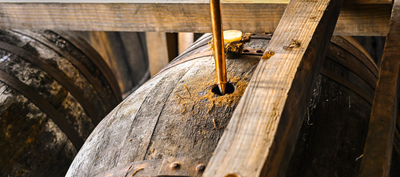


In the long, cool hush of a Speyside warehouse, where the air carries the quiet perfume of oak and time, there is a particular kind of patience at work. It is not the impatience of markets or the urgency of trends, but something slower, almost geological - a conversation between spirit and wood that unfolds over decades. Barrels rest in darkness, breathing gently through their staves, yielding and taking in equal measure. What emerges, eventually, is not merely whisky, but a record of time itself.
It is within this tradition that Douglas Laing’s Xtra Old Particular range has established its reputation: as a careful curator of rare, single cask Scotch whisky drawn from some of Scotland’s most revered - and occasionally lost - distilleries. These are not blends shaped to consistency, nor expressions softened for mass appeal. They are singular, often idiosyncratic casks, bottled with a light hand and a firm belief in what the company calls its “As Natural As It Gets” philosophy: no colouring, no chill-filtration, no interference between the cask and the glass.
Among these releases, a Speyside single malt whisky distilled in December 1997 at Glen Spey now emerges with quiet authority. After twenty-five years of maturation in a refill butt, it has been bottled at natural cask strength - 55.6% ABV - yielding just 370 bottles worldwide. It is, in the precise language of whisky, a 25 year old whisky, a single cask Scotch whisky, and a limited edition whisky; but those descriptors, while accurate, only gesture toward its deeper appeal.
To understand what makes such a whisky significant is to consider the nature of a single cask itself. Unlike standard releases, which are married from multiple barrels to achieve a consistent house style, a single cask is an individual. It carries the imprint of its specific oak vessel, its precise warehouse position, its own microclimate of temperature and humidity. No two are alike. For collectors and enthusiasts, this individuality is not a flaw but a fascination: each bottle becomes a finite expression, unrepeatable once the cask is emptied.
Cask strength, too, plays its role. By bottling the whisky at 55.6% ABV, Douglas Laing resists the dilution that often smooths and standardises flavour. Instead, the whisky arrives in its most direct form - intense, structured, and alive with the compounds drawn from both spirit and wood. For those who understand whisky, this is less about power than about integrity: a cask strength whisky offers the drinker control, whether to sip neat or to open it gradually with water, revealing its layers.
Speyside, of course, provides the stage. The region has long been associated with elegance and fruit-driven character, a contrast to the maritime smoke of Islay or the muscular austerity of certain Highland malts. Yet within Speyside there exists a spectrum, and Glen Spey, often understated, can yield whiskies of surprising depth when given time. Twenty-five years is more than time - it is transformation.
On the nose, this whisky does not announce itself loudly. Instead, it unfolds with a measured grace: orange zest lifted gently from the glass, a crystalline sweetness reminiscent of barley sugar, and a soft thread of spice that seems to hover rather than press. There is fruit here, but it is restrained, developing slowly, as though emerging from behind a veil.
The palate offers a different register. Richness arrives first, not heavy but assured, followed by layers of mature dark fruits - plums, perhaps, or the darker edge of stewed berries - interwoven with the influence of the refill butt. The cask has not overwhelmed the spirit; rather, it has framed it, lending warmth and spice without obscuring its core. A bright citrus lift moves through the centre, preventing the whisky from settling into excess, giving it a sense of balance that feels almost architectural.
And then the finish, which lingers with the quiet confidence of something well made. Buttery pastry notes soften into tangy marmalade, while softly stewed apples carry the experience forward, long after the glass is set down. It is, in the truest sense, an elegant conclusion - one that does not rush to depart.
For those asking whether such a whisky is “worth it,” the answer depends on what one seeks. If whisky is merely a drink, then perhaps not. But if it is an encounter - with craft, with time, with the subtle differences that define rarity - then a bottle like this occupies a different category altogether. It becomes not just a possession, but an experience held in reserve.
The question of age often arises here. Is older whisky always better? Not necessarily. Age can deepen complexity, but it can also diminish vitality if the cask oversteps its role. What distinguishes a well-aged whisky is not simply the number of years, but the balance achieved over them. In this case, twenty-five years have allowed the spirit to mature without surrendering its identity - a balance that is increasingly difficult to find.
Scarcity, inevitably, shapes perception. With only 370 bottles in existence, this is not a whisky that will circulate widely or remain available indefinitely. The modern whisky market, particularly at the higher end, has begun to recognise such releases not only as objects of enjoyment but as forms of rare whisky investment - assets whose value may appreciate as availability declines. Yet to frame this bottle purely in financial terms would be to miss its more immediate, sensory reward.
There is also, quietly, the matter of authenticity. In an era where production shortcuts and visual enhancements can obscure provenance, the decision to present a whisky without colouring or chill-filtration is not merely technical. It is philosophical. It signals a trust in the cask, and in the drinker - a belief that what has been created over decades requires no embellishment.
And so the whisky returns us to that warehouse in Speyside, to the stillness in which it spent its years. One imagines the cask, set among many, indistinguishable at first glance, yet carrying within it the potential for something singular. When it was finally drawn and bottled, it ceased to be part of a collection of barrels and became instead a finite set of moments, captured in glass.
To hold such a bottle is to hold, in some small way, that passage of time. Not in abstraction, but in a form that can be poured, considered, and shared—or perhaps kept, waiting for the right occasion, or the right company. There is no urgency imposed, only the quiet knowledge that once opened, it will not return.
And perhaps that is its final appeal. In a world that accelerates constantly, a whisky like this asks for something different: attention, patience, and a willingness to engage with what has been decades in the making. It does not demand ownership, but it suggests it—gently, persuasively, as all rare things do.
