
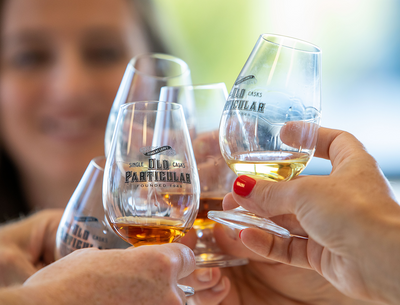
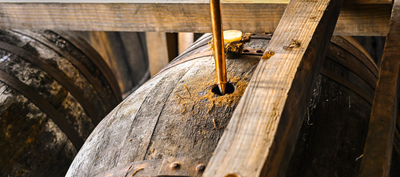


There is a particular stillness to Speyside in late autumn, when the air sharpens and the distillery yards fall quiet long before dusk. Warehouses, low and unassuming, hold within them a different tempo entirely - one not governed by shifts or seasons, but by the gradual, invisible exchange between oak and spirit. Inside, casks rest in rows like sleeping archives, each one quietly composing its own version of time.
It is from this patient, almost monastic environment that the most compelling Scotch whiskies emerge - not as products, but as outcomes. The best among them resist intervention, shaped less by design than by stewardship. For independent bottlers such as Douglas Laing, whose Xtra Old Particular range has long been devoted to singularity rather than standardisation, the role is not to create but to recognise. To find the cask that, after decades, has something precise and complete to say.
Within that philosophy, a rare Speyside single malt whisky distilled at Braeval in August 1991 now comes into focus. Bottled in January 2022 as part of the XOP series, this Braeval 30 year old single cask Scotch whisky represents a convergence of time, restraint, and circumstance. Matured in a refill barrel for three decades and bottled at natural cask strength - 50.2% ABV - it exists in a strictly limited outturn of just 230 bottles worldwide. It is, by any meaningful definition, a limited edition whisky, but more importantly, it is a complete and unrepeatable expression of its cask.
To understand the significance of such a whisky is to begin with the idea of the single cask itself. In a market often defined by consistency, a single cask Scotch whisky stands apart precisely because it resists it. Each cask evolves under slightly different conditions - its position in the warehouse, the permeability of its wood, the slow variations in temperature that coax the spirit in and out of the oak. The result is individuality. Once bottled, it cannot be recreated, only remembered.
Braeval, a distillery often operating outside the spotlight, lends itself well to this kind of discovery. Its spirit, characteristically light and floral in youth, gains quiet complexity over time, particularly when matured in refill wood. Unlike first-fill casks, which impose a more assertive influence, a refill barrel allows the distillate to remain central, evolving gradually rather than being overtaken. After thirty years, what emerges is not simply older whisky, but something more integrated - less about age as a number, and more about balance as an achievement.
On the nose, this whisky introduces itself with a certain composure. There is the immediate suggestion of vanilla fudge and soft toffee, familiar yet refined, followed by a gentle warmth - cinnamon and spiced oak - that seems to rise rather than assert itself. It is not a whisky that demands attention at first encounter; it rewards it. Given a moment, a softer sweetness develops beneath, suggesting the kind of depth that only time can produce.
The palate shifts register. Texture becomes the defining element - silky, almost weightless, yet carrying a surprising richness. Malted barley forms the backbone, but it is accompanied by notes that feel both nostalgic and precise: sweet boiled candies, a bright thread of tangerine citrus that cuts through the sweetness without diminishing it. This is where the decision to bottle at cask strength reveals its purpose. At 50.2%, the whisky retains its structure and vitality, offering a clarity of flavour that dilution might have softened. For the drinker, it presents an opportunity - to experience the whisky as it exists, or to shape it incrementally, adding water to unlock further nuances.
The finish extends the conversation rather than concluding it. There is an elegance here that feels almost architectural: buttery pastry notes unfolding into tangy marmalade, with softly stewed apples lingering at the edge. It is long, certainly, but more than that, it is composed. Nothing rushes; nothing dissipates abruptly. The whisky leaves an impression not of intensity, but of completeness.
In considering why such a whisky matters, the question inevitably turns to age. Thirty years is a threshold that carries both expectation and risk. It suggests rarity - few casks endure this long with their character intact - but it does not guarantee quality. Indeed, age can as easily diminish as enhance. What distinguishes this Braeval is not simply that it has reached three decades, but that it has done so without losing coherence. The spirit remains present, the cask supportive rather than dominant. It is a reminder that maturity, in whisky as in other pursuits, is measured not in duration alone, but in balance.
Speyside itself provides part of the answer. The region has long been associated with elegance, fruit, and a certain approachability, but these qualities can deepen significantly over time. In older expressions, the bright orchard fruits of youth often evolve into something richer, more layered, without sacrificing their underlying clarity. This is what gives a well-aged Speyside single malt whisky its enduring appeal: it offers complexity without obscurity, depth without heaviness.
For collectors, the significance of a release like this extends beyond the glass. With only 230 bottles available, scarcity is not a marketing construct but a practical reality. Once dispersed, the cask ceases to exist as a source; its contents become finite, held privately or shared sparingly. In recent years, such releases have increasingly been viewed through the lens of rare whisky investment, their value shaped by both their intrinsic qualities and their diminishing availability. Yet to regard this Braeval solely as an asset would be to overlook its more immediate purpose.
There is, embedded within the XOP philosophy, a commitment to authenticity that resists embellishment. No colouring has been added to standardise its appearance; no chill-filtration has been applied to alter its texture. These choices are not incidental. They reflect a belief that whisky, when it has reached this level of maturity, requires no adjustment. What is presented is what the cask has given - nothing more, nothing less.
This raises, finally, the question often posed by those encountering such whiskies for the first time: is a 30 year old whisky worth it? The answer depends less on price than on perspective. For those seeking a casual drink, perhaps not. But for those interested in whisky as a form of expression - as something shaped by time, place, and restraint - it offers something increasingly rare. Not just flavour, but context. Not just enjoyment, but understanding.
To encounter a whisky like this is to engage with a specific moment in a much longer story. The barley was grown, the spirit distilled, the cask filled - all at a time when the world itself was different. For thirty years, it remained largely untouched, evolving quietly while everything around it changed. What arrives now, in a bottle of Braeval 30 Years Old, is not merely the sum of those years, but their distillation.
And so the choice it presents is not urgent, but considered. To acquire such a bottle is not simply to purchase whisky, but to take custodianship of something finite. To decide whether to open it, to share it, or to keep it intact is part of its meaning. In that sense, its rarity is not only in its number, but in the kind of attention it invites.
There are, after all, few things left that ask us to slow down. This is one of them.

